
Akinetopsia
Definition and Clinical Features
Akinetopsia, also known as cerebral visual motion blindness, is a rare and specific inability to perceive objects in motion. A person with akinetopsia sees the world as a series of static "frames" rather than a smooth, continuous flow. For example, a moving car might appear to jump from one position to the next without any perception of the movement in between.
Crucially, other visual attributes such as color, form, and depth perception remain intact. This specific dissociation between static and motion vision is sometimes referred to as Riddoch’s phenomenon. The inverse condition, where motion vision is selectively spared in a blind visual field (scotoma), also highlights the brain's specialized motion-processing system.
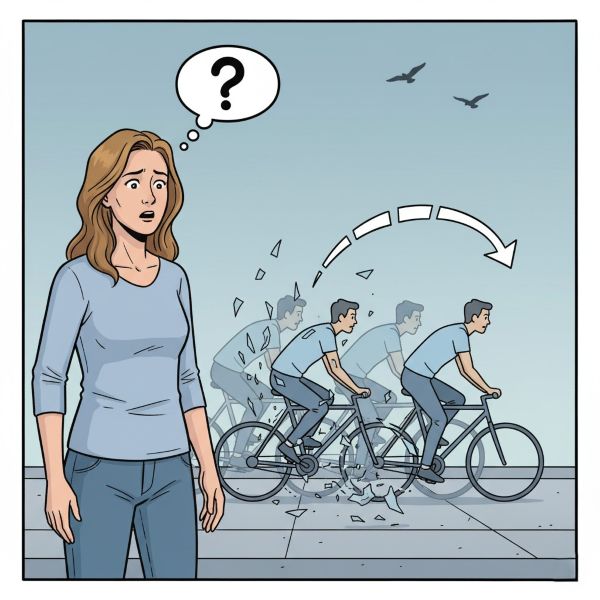
In akinetopsia, a moving object is perceived as a series of static images, with the brain unable to process the motion between them.
Anatomical Basis and Clinical Associations
Akinetopsia is exceptionally rare and suggests a distinct neuroanatomical substrate for movement vision. It is caused by lesions that selectively damage area V5 (also known as the middle temporal or MT area) of the visual cortex, a region specialized for processing motion. Such damage is typically bilateral for the full syndrome to manifest.
Clinically, due to the location of the causative lesions, akinetopsia may be associated with other neurological deficits, such as acalculia (difficulty with arithmetic) and aphasia (language disturbance).
References
Zihl J, Von Cramon D, Mai N. Selective disturbance of movement vision after bilateral brain damage. Brain 1983; 106: 313-340
Zeki S. Cerebral akinetopsia (cerebral visual motion blindness). Brain 1991; 114: 811-824
Cross References
Acalculia; Aphasia; Riddoch’s phenomenon
Need Expert Advice on Your Condition?
Get a personalized video breakdown and treatment plan from our senior neurosurgeons using your MRI/CT scans.
👉 Request MRI Review