
Acalculia
Definition and Types
Acalculia, or dyscalculia, is an acquired difficulty or inability in performing simple mental arithmetic. This complex function depends on two processes: number processing and calculation. A deficit confined specifically to the calculation process is termed anarithmetia.
Acalculia is broadly classified as:
- Primary Acalculia: A specific deficit in arithmetical tasks that is more severe than any other coexisting cognitive dysfunction. This is a pure disorder of calculation.
- Secondary Acalculia: This is the more common variety, where the calculation difficulty occurs in the context of other cognitive impairments, such as language deficits (aphasia, alexia, or agraphia for numbers), attention, memory, or spatial perception (e.g., neglect).
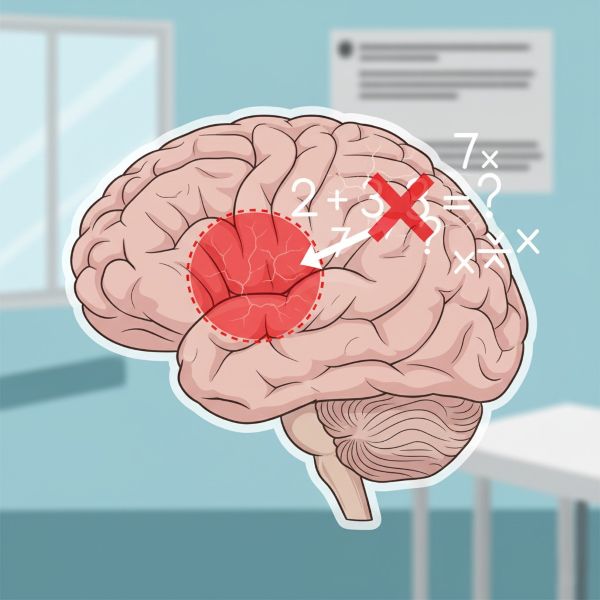
Acalculia is frequently caused by lesions in the dominant (left) parietal lobe, particularly the angular gyrus.
Pathophysiology and Anatomical Correlates
Isolated acalculia may be seen with lesions of the:
- Dominant (left) parietal/temporal/occipital cortex, especially involving the angular gyrus (Brodmann areas 39 and 40).
- Medial frontal lobe, potentially related to impaired problem-solving ability.
- Subcortical structures such as the caudate nucleus, putamen, and internal capsule.
Impairments can be remarkably specific; for example, a patient might lose the ability to perform addition and multiplication while the ability to subtract is preserved. In patients with mild to moderate Alzheimer’s disease, dyscalculia has been linked to impaired cerebral glucose metabolism in the left inferior parietal lobule and inferior temporal gyrus.
Clinical Significance and Associated Syndromes
Acalculia is a key component of Gerstmann syndrome, which results from lesions of the dominant parietal lobe and also includes agraphia (inability to write), finger agnosia (inability to identify fingers), and right-left disorientation.
Interestingly, the preservation of calculation skills has been reported in cases of severe language dissolution (both production and comprehension) due to focal left temporal lobe atrophy, likely from Pick’s disease. This dissociation highlights that calculation can be an independent cognitive function.
References
Benson DF, Ardila A. Aphasia: a clinical perspective. New York: OUP, 1996: 235-251
Boller F, Grafman J. Acalculia: historical development and current significance. Brain and Cognition 1983; 2: 205-223
Butterworth B. The mathematical brain. London: Macmillan, 1999
Denburg N, Tranel D. Acalculia and disturbances of body schema. In: Heilman KM, Valenstein E (eds.). Clinical neuropsychology (4th edition). Oxford: OUP, 2003: 161-184
Gitelman DR. Acalculia: a disorder of numerical cognition. In: D’Esposito M (ed.). Neurological foundations of cognitive neuroscience. Cambridge: MIT Press, 2003: 129-163
Hirono N, Mori E, Ishii K et al. Regional metabolism: associations with dyscalculia in Alzheimer’s disease. Journal of Neurology, Neurosurgery and Psychiatry 1998; 65: 913-916
Lampl Y, Eshel Y, Gilad R, Sarova-Pinhas I. Selective acalculia with sparing of the subtraction process in a patient with a left parietotemporal hemorrhage. Neurology 1994; 44: 1759-1761
Rossor M, Warrington EK, Cipolotti L. The isolation of calculation skills. Journal of Neurology 1995; 242: 78-81
Cross References
Agraphia; Alexia; Aphasia; Gerstmann syndrome; Neglect
Need Expert Advice on Your Condition?
Get a personalized video breakdown and treatment plan from our senior neurosurgeons using your MRI/CT scans.
👉 Request MRI Review