
Anhidrosis
Definition and Clinical Features
Anhidrosis, or hypohidrosis, is a complete loss or lack of sweating. It is a negative autonomic sign indicating a failure of the sudomotor system. Patients may notice a lack of perspiration in specific areas of the body or generally, often accompanied by heat intolerance.
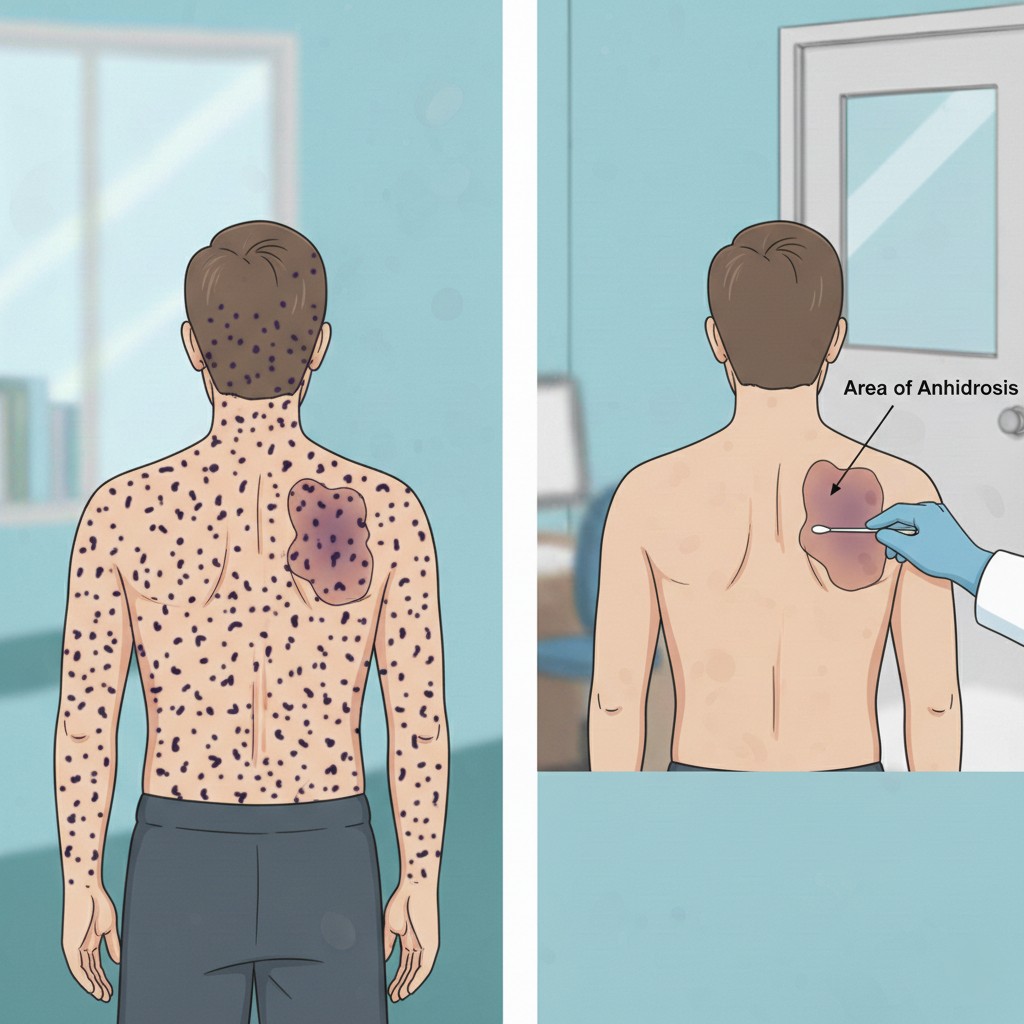
Areas of anhidrosis can be mapped clinically using tools like the thermoregulatory sweat test or the starch-iodine (Minor's) test.
Pathophysiology
Sweating is controlled by the sympathetic nervous system (specifically, sympathetic cholinergic fibers). Anhidrosis may be due to primary autonomic failure, or to pathology within the posterior hypothalamus (the "sympathetic area"). Any lesion interrupting the descending autonomic pathways from the hypothalamus, the spinal cord, the sympathetic chain, or the peripheral nerves can result in an inability to sweat in the corresponding dermatomal or regional distribution.
Clinical Examination Technique
Clinically, anhidrosis is suspected when a patient's skin remains dry, hot, and flushed during heat exposure or exertion. Bedside assessment can involve running the back of a smooth object (like a reflex hammer handle) across the skin; it will glide smoothly over dry, anhidrotic skin but experience friction over normal, slightly moist skin. Formal quantitative assessments include the Quantitative Sudomotor Axon Reflex Test (QSART), thermoregulatory sweat tests, or the starch-iodine test, which produces a color change only in areas where active sweating occurs.
Associated Conditions
Anhidrosis may occur in various neurological disorders, including:
- Multiple system atrophy and Parkinson’s disease (primary autonomic failure)
- Multiple sclerosis
- Spinal cord lesions (presenting caudal to the lesion level)
- Hereditary sensory and autonomic neuropathies (HSAN)
- Holmes-Adie syndrome (where localized or generalized anhidrosis may be seen, known as Ross syndrome)
- Horner’s syndrome (where unilateral facial anhidrosis is seen; classically, facial anhidrosis is present with central or preganglionic lesions, while postganglionic lesions distal to the superior cervical ganglion may spare facial sweating or cause only localized medial forehead anhidrosis)
Clinical Significance
The primary danger of generalized anhidrosis is the loss of the body's main thermoregulatory cooling mechanism. Patients are at a significantly increased risk of hyperthermia, heat exhaustion, and heatstroke, especially during physical exertion or in hot environments. Identifying the anatomical pattern of anhidrosis is highly valuable for localizing the underlying neurological lesion.
References
Cheshire WP, Freeman R. Disorders of sweating. Seminars in Neurology 2003; 23(4): 399-406
Low PA. Autonomic nervous system function. Journal of Clinical Neurophysiology 1993; 10(1): 14-27
Cross References
Holmes-Adie pupil, Holmes-Adie syndrome; Horner’s syndrome; Hyperhidrosis
Need Expert Advice on Your Condition?
Get a personalized video breakdown and treatment plan from our senior neurosurgeons using your MRI/CT scans.
👉 Request MRI Review