
Allokinesia
Definition and Clinical Features
Allokinesia is a motor disorder in which a patient, when asked to move a limb on one side of the body, instead moves the contralateral limb. This transposition of the intended movement to the wrong side may also involve moving in the wrong direction. For example, when asked to lift their left arm, the patient may lift their right arm instead.
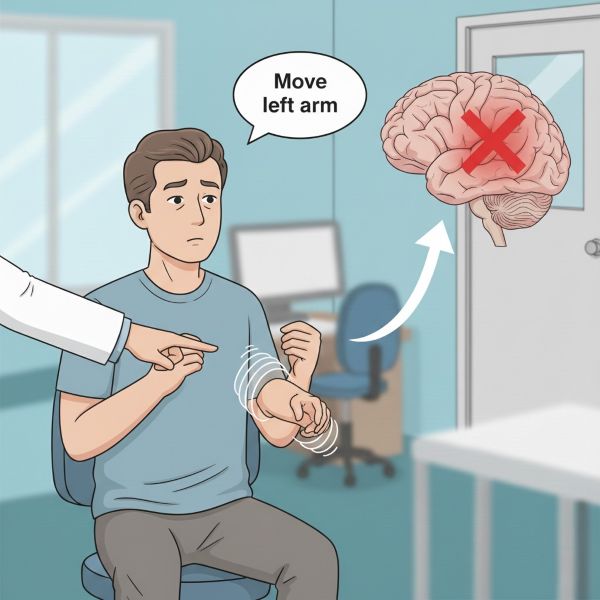
In allokinesia, a command to move the limb on the neglected (left) side results in an unintended movement of the limb on the non-neglected (right) side.
Clinical Significance and Anatomical Basis
Allokinesia is considered the motor counterpart to sensory mislocalization phenomena like alloesthesia (where a stimulus is felt on the wrong side). It is a feature of the hemispatial neglect syndrome and is typically seen with lesions of the right cerebral hemisphere, particularly affecting frontoparietal networks involved in spatial attention and motor planning.
Cross References
Allochiria; Alloesthesia; Neglect
Need Expert Advice on Your Condition?
Get a personalized video breakdown and treatment plan from our senior neurosurgeons using your MRI/CT scans.
👉 Request MRI Review