
Absence
Absence
An absence, or absence attack, is a brief interruption of awareness of epileptic origin. It is a type of generalized non-motor seizure characterized by a sudden, short-lived lapse of consciousness.
History and Etymology
Historically, absence seizures were known as "petit mal" (French for "little illness"), a term used to differentiate them from the more dramatic convulsive "grand mal" seizures. While the term "petit mal" is still sometimes used, modern classification prefers "absence seizure" to describe this specific event more accurately.
Pathophysiology
Absence seizures are caused by abnormal, synchronized electrical activity in the brain. The characteristic electroencephalogram (EEG) finding is a generalized 3 Hz spike-and-slow-wave discharge pattern. This abnormal rhythm is believed to originate from dysfunctional oscillatory circuits connecting the thalamus and the cerebral cortex (thalamocortical circuits).
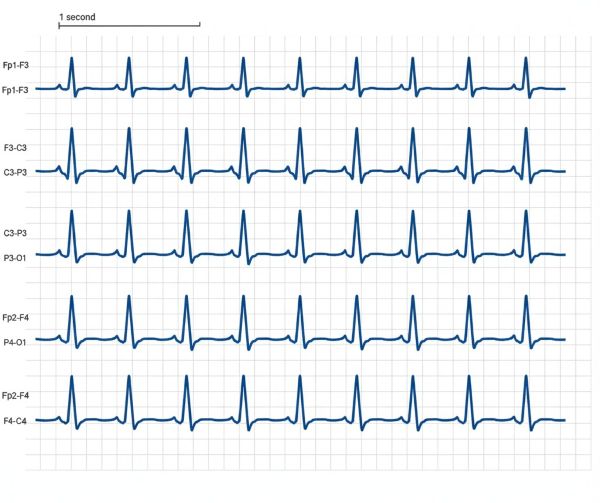
The classic EEG pattern of a typical absence seizure, showing generalized 3 Hz spike-and-slow-wave discharges.
Clinical Examination and Diagnosis
The clinical hallmark is a brief interruption of awareness, which may be a barely noticeable suspension of speech or attentiveness. The person abruptly stops all activity and stares blankly. The episode ends as suddenly as it begins, typically without postictal confusion or any awareness that an attack has occurred. Diagnosis is confirmed by an EEG that captures the characteristic spike-wave pattern, which can often be provoked in a clinical setting by hyperventilation.
Associated Conditions and Types
Absence seizures are the defining feature of idiopathic generalized epilepsy of absence type (childhood absence epilepsy), a disorder exclusive to childhood. These are known as "typical absences."
They should be distinguished from "atypical absences," which may have a more gradual onset and offset, more pronounced changes in muscle tone, and are associated with more severe epilepsy syndromes like Lennox-Gastaut syndrome. Absence epilepsy may also be confused with a more obvious distancing, "trance-like" state, or "glazing over", possibly with associated automatisms, such as lip smacking, due to a complex partial seizure of temporal lobe origin.
Clinical Significance and Treatment
Although brief, frequent absence seizures can significantly impact a child's learning, social development, and daily functioning, often being misinterpreted as inattentiveness or daydreaming. Correct diagnosis is crucial as treatment differs based on seizure type. Ethosuximide and/or sodium valproate are the treatments of choice for idiopathic generalized absence epilepsy. In contrast, carbamazepine, sodium valproate, or lamotrigine are first-line agents for localization-related complex partial seizures. Notably, some medications for partial seizures (like carbamazepine) can worsen absence seizures.
References
- Panayiotopoulos CP. A Clinical Guide to Epileptic Syndromes and their Treatment. Springer, 2010.
- Engel J Jr, Pedley TA, eds. Epilepsy: A Comprehensive Textbook. Lippincott Williams & Wilkins, 2008.
- Blumenfeld H. Neuroanatomy through Clinical Cases. Sinauer Associates, 2010.
Cross References
Need Expert Advice on Your Condition?
Get a personalized video breakdown and treatment plan from our senior neurosurgeons using your MRI/CT scans.
👉 Request MRI Review