
Thoracic Spine CT Scan
What is a Thoracic Spine CT Scan?
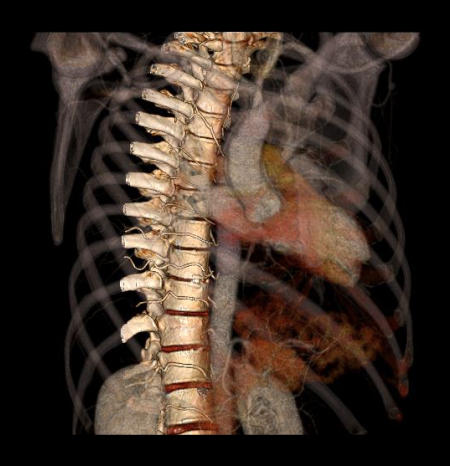
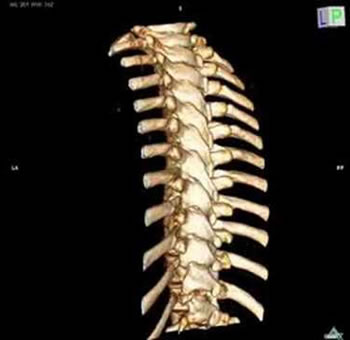
A Computed Tomography (CT) scan of the thoracic spine is an advanced imaging modality that focuses specifically on the middle section of the back. It captures highly detailed cross-sectional images of the 12 thoracic vertebrae (T1 through T12), the facet joints, costovertebral joints, and the ribs that attach to them.
Because the thoracic spine is structurally tethered to the rib cage, it is much more rigid than the cervical or lumbar spine. As a result, standard X-rays of the mid-back are often obscured by the ribs, lungs, and sternum. A CT scan bypasses these obstacles, offering neurosurgeons and orthopedic specialists a precise, unobstructed 3D view of the bony architecture.
Clinical Indications for Thoracic CT
While disc herniations are relatively rare in the mid-back due to its rigidity, the thoracic spine is highly susceptible to other specific pathologies. A CT scan is critically indicated for:
- High-Energy Trauma: To detect burst fractures, compression fractures, or fracture-dislocations following a severe fall, sports injury, or motor vehicle accident. CT is the gold standard for assessing thoracic spine stability in the ER.
- Osteoporotic Compression Fractures: In elderly patients or those with severe osteoporosis, the front of the thoracic vertebrae can slowly collapse. A CT scan helps determine if a patient is a candidate for percutaneous vertebroplasty or kyphoplasty.
- Spinal Tumors and Metastases: The thoracic spine is a common site for the spread (metastasis) of lung, breast, and prostate cancers. CT imaging with contrast is excellent for detecting osteolytic (bone-destroying) or osteoblastic (bone-forming) lesions.
- Ossification of the Ligamentum Flavum (OLF) or Posterior Longitudinal Ligament: CT is vastly superior to MRI for identifying these calcifications that can compress the spinal cord.
- Postoperative Evaluation: Assessing spinal instrumentation, fusion mass, or hardware complications in the thoracic region.
Need Expert Advice on Your Condition?
Get a personalized video breakdown and treatment plan from our senior neurosurgeons using your MRI/CT scans.
👉 Request MRI ReviewThe CT Procedure
A thoracic spine CT scan is fast and painless, typically lasting 5–15 minutes. The patient lies on a motorized table that moves through the doughnut-shaped CT scanner. The technologist may instruct the patient to hold their breath briefly to reduce motion artifacts from breathing. Intravenous contrast is sometimes used when evaluating tumors, infection, or vascular structures, but is often not required for routine bony assessment.
Modern multidetector scanners produce very thin slices (0.5–1 mm) and allow excellent multiplanar and 3D reconstructions for surgical planning.
Common Findings in the Thoracic Spine
When analyzing a thoracic CT scan, neurosurgeons look for specific markers that explain mid-back pain or neurological symptoms:
- Vertebral Compression Fractures (VCF): A loss of vertebral body height, resulting in a wedge-shaped vertebra that contributes to a "hunchback" posture (hyperkyphosis).
- Spondylosis and Osteophytes: Advanced osteochondrosis leads to the formation of large bone spurs. In the thoracic spine, large anterior osteophytes are common but usually asymptomatic; posterior osteophytes, however, can encroach on the spinal canal.
- Costovertebral Joint Arthropathy: Degenerative arthritis where the ribs articulate with the thoracic vertebrae. This can cause severe, localized pain that worsens with deep breathing or twisting motions, often mimicking cardiac or pulmonary pain.
- Spinal Cord Compression: Although MRI is primary for soft tissue, CT clearly shows bony fragments, calcifications, or tumor masses encroaching upon the thoracic spinal cord.
Advantages and Limitations
Advantages:
- Superior bone detail and 3D reconstructions — ideal for trauma, fractures, and surgical planning.
- Fast scanning time, suitable for emergency settings and patients who cannot tolerate long MRI exams.
- Excellent for patients with MRI contraindications (pacemakers, metallic implants, claustrophobia).
- Highly effective at detecting calcifications (e.g., OLF) and subtle fractures missed on X-rays.
Limitations:
- Uses ionizing radiation (though dose-reduction protocols are now standard).
- Limited soft tissue contrast compared to MRI — may miss early disc herniations or cord edema without contrast.
- Rib and lung overlap can still pose challenges in some cases, though far less than with plain films.
Patient Preparation and Radiation Safety
Preparation:
- No special fasting is usually required.
- Inform staff if you are pregnant, have kidney disease, or allergy to contrast material.
- Remove any metal objects, jewelry, or clothing with metal parts from the chest/back area.
Radiation Safety: A thoracic spine CT delivers a moderate radiation dose. Modern scanners use advanced dose optimization techniques (iterative reconstruction, automatic exposure control). The diagnostic benefit in trauma, tumor staging, or surgical planning far outweighs the small risk for most patients.
References
- Daffner RH, Hackney DB. ACR Appropriateness Criteria on suspected spine trauma. J Am Coll Radiol. 2007;4(11):762-775.
- Georgy BA, Snow ND. Bone cement in the thoracic and lumbar spine: CT evaluation. Radiology. 2000;216(1):159-164.
- Ahn UM, Ahn NU, Nallamshetty L, et al. The etiology of thoracic intervertebral disc herniations. Am J Orthop (Belle Mead NJ). 2002;31(3):142-149.
- Additional sources: American College of Radiology (ACR) Appropriateness Criteria and recent thoracic spine imaging guidelines (2023–2026).
See also
- Abdominal CT scan
- Brain and skull base CT scan
- Brain Perfusion CT scan
- Cerebrovascular CT-angiography
- Coronary CT-angiography and computed tomography of the heart
- CT Myelography
- CT study principle
- CT Venography (CTV) of the Brain
- Paranasal sinuses CT scan
- Pelvic CT scan
- Temporal Bone / Internal Auditory Canal CT scan
- Thorax (chest) CT scan
- Vertebral spine CT scan (Overview)
Need Expert Advice on Your Condition?
Get a personalized video breakdown and treatment plan from our senior neurosurgeons using your MRI/CT scans.
👉 Request MRI Review