
CT Venography (CTV) of the Brain
What is CT Venography (CTV)?
Computed Tomography Venography (CTV) of the brain is a highly targeted contrast-enhanced imaging study designed to visualize the complex network of cerebral veins and the major dural venous sinuses (such as the superior sagittal sinus, transverse sinuses, sigmoid sinuses, and straight sinus). These structures act as the drainage system for the brain, carrying deoxygenated blood and cerebrospinal fluid back to the heart.
While standard CT Angiography (CTA) focuses on the high-pressure arterial system that feeds the brain, CTV is specifically calibrated to look at the low-pressure venous return system. This distinction is critical for diagnosing rare but highly dangerous causes of elevated intracranial pressure and venous strokes.
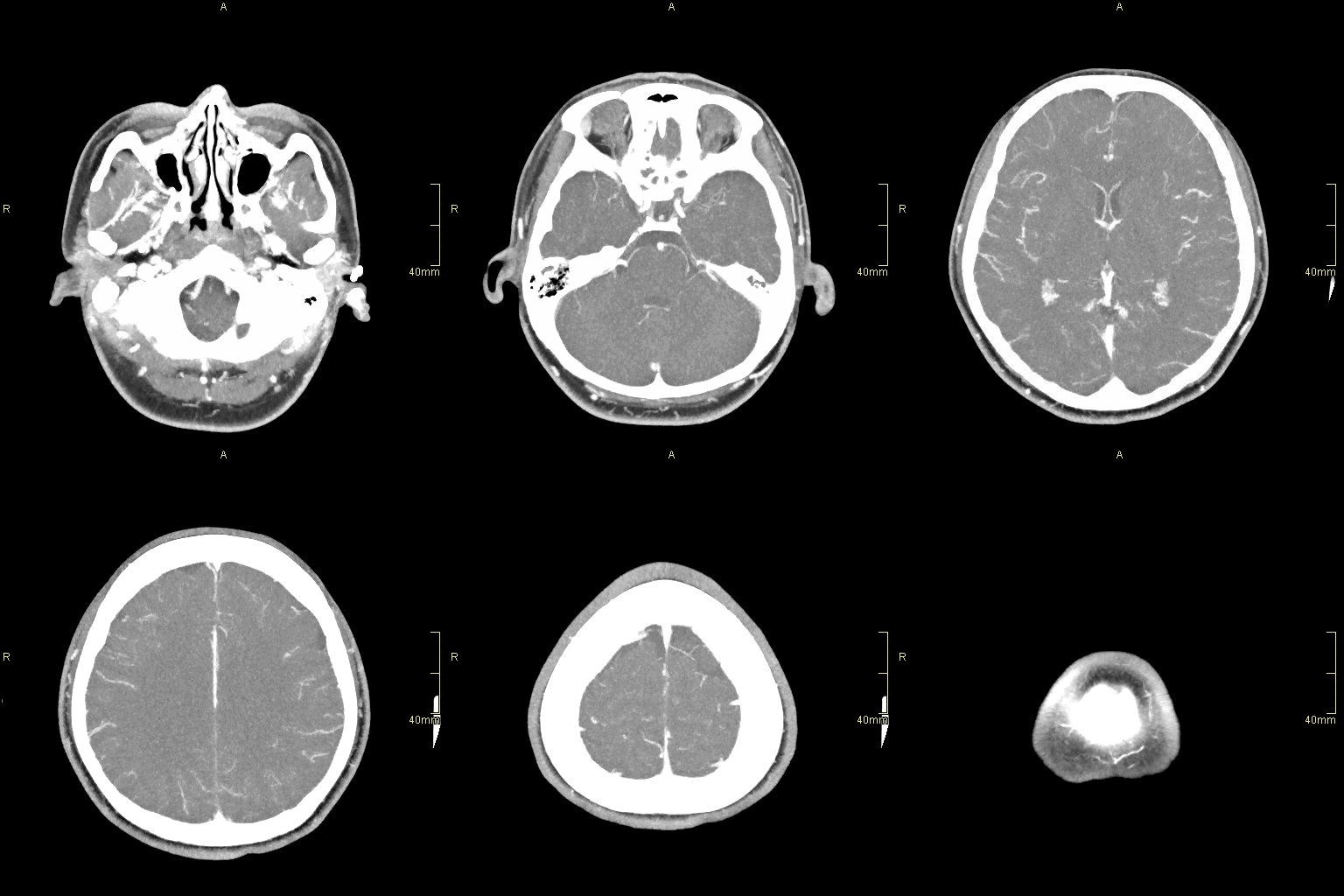
Clinical Indications for Brain CTV
Neurosurgeons and neurologists rely on CTV primarily to diagnose conditions where blood is failing to drain properly from the skull. Indications include:
- Cerebral Venous Sinus Thrombosis (CVST): The primary indication for CTV. This is a rare, severe condition where a blood clot forms in one of the major dural sinuses, preventing blood from draining out of the brain. It causes severe, sudden headaches, visual disturbances, seizures, and can lead to a venous ischemic stroke or hemorrhage. CVST is more common in young adults, particularly those with genetic clotting disorders or women during pregnancy/post-partum. On a CTV, a clot appears as an "empty delta sign" (a dark defect inside the bright, contrast-filled sinus).
- Idiopathic Intracranial Hypertension (IIH): Also known as pseudotumor cerebri, this condition causes high pressure inside the skull without an obvious tumor or blockage. CTV is used to evaluate if there is a severe anatomical narrowing (stenosis) of the transverse venous sinuses driving the pressure up. If severe stenosis is found, venous stenting might be considered.
- Tumor Compression or Invasion: To determine if a large brain tumor (such as a meningioma) has invaded or is physically compressing a major venous sinus, which drastically alters the surgical approach for removal.
- Pulsatile Tinnitus: A rhythmic "whooshing" sound in the ear that beats in time with the patient's pulse can be caused by abnormal venous blood flow near the temporal bone. CTV helps map these vascular anomalies.
Need Expert Advice on Your Condition?
Get a personalized video breakdown and treatment plan from our senior neurosurgeons using your MRI/CT scans.
👉 Request MRI ReviewCTV vs. CTA: The Timing Difference
The primary difference between a CT Angiogram (arteries) and a CT Venogram (veins) is entirely based on the timing of the scanner.
When the iodine contrast dye is injected into the patient's arm, it takes a specific number of seconds to travel through the heart, up the carotid arteries into the brain (the arterial phase), and then drain out into the cerebral veins (the venous phase).
For a standard CTA, the scanner fires almost immediately after injection to catch the dye in the arteries. For a CTV, the technologist employs a deliberate delay (typically 40 to 50 seconds) before capturing the images, ensuring the dye has fully saturated the slower-moving dural venous sinuses. Often, both a CTA and a CTV are performed back-to-back during the same hospital visit to provide a complete map of the brain's circulation.
The Procedure
A Brain CT Venography is quick and usually takes 10–20 minutes. An intravenous line is placed in the arm, and a bolus of iodinated contrast is injected. After a short delay to allow venous filling, the CT scanner acquires high-resolution images of the head. Multiplanar and 3D reconstructions are then generated for detailed evaluation of the venous sinuses and cortical veins. The procedure is often combined with non-contrast CT or CTA.
Interpretation of Results
Radiologists look for:
- Filling Defects: Dark areas within brightly contrast-filled sinuses indicating thrombosis.
- Stenosis or Narrowing: Especially in the transverse sinuses in IIH.
- Collateral Circulation: Development of alternative venous pathways due to chronic occlusion.
- Sinus Invasion/Compression: By tumors or other masses.
Findings are correlated with clinical symptoms and may be confirmed with MR Venography if needed.
Advantages and Limitations
Advantages:
- Fast, widely available, and excellent for emergency diagnosis of CVST.
- High spatial resolution with good 3D reconstructions.
- Less affected by patient motion than MRI in acute settings.
- Can be combined with CTA and standard CT in one session.
Limitations:
- Uses ionizing radiation and iodinated contrast (risk of allergy or kidney issues).
- May overestimate stenosis due to flow artifacts.
- Less sensitive than MRV for slow flow or subtle chronic changes in some cases.
- Invasive contrast administration carries minor risks.
Patient Preparation and Safety
Preparation:
- No special fasting is usually required unless combined with other procedures.
- Inform the team about kidney function, previous contrast reactions, pregnancy, or metformin use.
- Good IV access is needed for contrast injection.
Safety: Radiation dose is comparable to a standard head CT with contrast. Modern protocols minimize exposure. Post-procedure hydration helps clear the contrast. The test is generally very safe and well-tolerated.
References
- Saposnik G, Barinagarrementeria F, Brown RD Jr, et al. Diagnosis and management of cerebral venous thrombosis: a statement for healthcare professionals from the American Heart Association/American Stroke Association. Stroke. 2011;42(4):1158-1192.
- Farb RI, Scott JN, Willinsky RA, et al. Intracranial venous system: gadolinium-enhanced three-dimensional MR venography with auto-triggered elliptic centric-ordered sequence--initial experience. Radiology. 2003;226(1):203-209.
- Linn J, Ertl-Wagner B, Seelos KC, et al. Diagnostic value of multidetector-row CT angiography in the evaluation of thrombosis of the cerebral venous sinuses. AJNR Am J Neuroradiol. 2007;28(5):946-952.
- Additional sources: American Heart Association guidelines and recent neuroimaging reviews (2023–2026).
See also
- Abdominal CT scan
- Brain and skull base CT scan
- Brain Perfusion CT scan
- Cerebrovascular CT-angiography
- Coronary CT-angiography and computed tomography of the heart
- CT Myelography
- CT study principle
- CT Venography (CTV) of the Brain
- Paranasal sinuses CT scan
- Pelvic CT scan
- Temporal Bone / Internal Auditory Canal CT scan
- Thorax (chest) CT scan
- Vertebral spine CT scan (Overview)
Need Expert Advice on Your Condition?
Get a personalized video breakdown and treatment plan from our senior neurosurgeons using your MRI/CT scans.
👉 Request MRI Review