
Brain Perfusion CT Scan
What is a Brain Perfusion CT Scan?
A Brain Perfusion CT Scan (CTP) is an advanced, highly specialized functional imaging test used in neurovascular emergencies. Unlike a standard Brain CT, which only takes a static picture of the brain's anatomy to look for bleeding, a CT Perfusion scan acts as a video, continuously measuring the exact flow of blood moving through the brain tissues (parenchyma) in real-time.
By injecting an iodine-based contrast dye into an arm vein and rapidly scanning the brain as the dye washes through the cerebral blood vessels, powerful software generates color-coded maps. These maps tell neurosurgeons and stroke neurologists precisely which areas of the brain are adequately supplied with oxygen and which areas are starving.
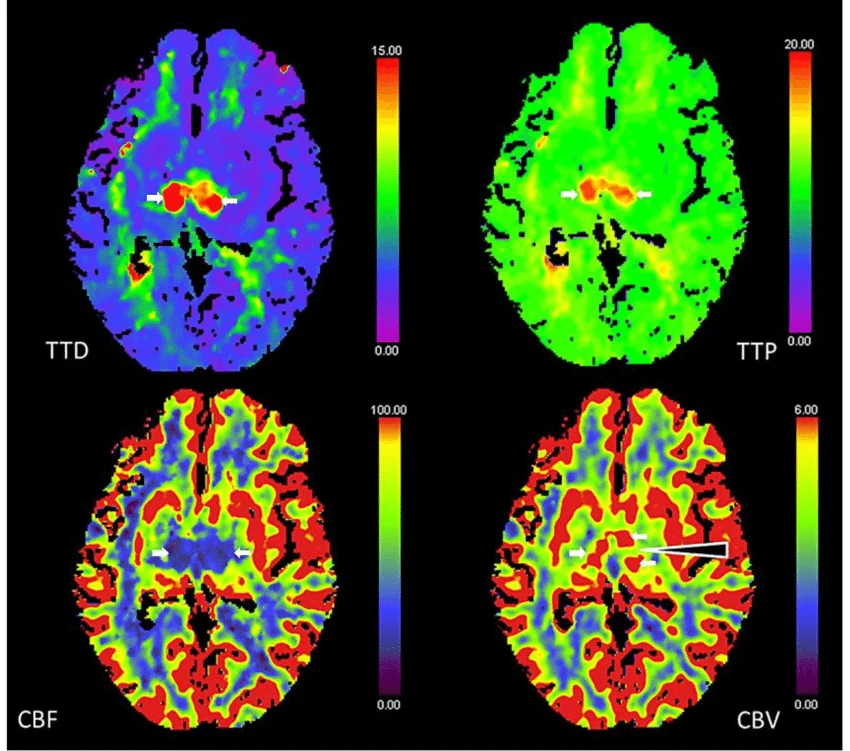
How CT Perfusion Works (The Ischemic Penumbra)
The primary clinical goal of a CTP is to solve the most critical question in an acute ischemic stroke: "Is there still brain tissue left to save?"
The scan calculates three primary metrics:
- Cerebral Blood Volume (CBV): The total amount of blood in a given area of brain tissue.
- Cerebral Blood Flow (CBF): How rapidly blood is moving through that tissue.
- Mean Transit Time (MTT) / Time to Peak (TTP): How long it takes the blood (and contrast dye) to pass through the micro-vessels of the brain.
When an artery is blocked by a clot, a central area of brain tissue dies quickly. This is the Infarct Core (irreversibly damaged tissue, marked by markedly reduced CBV and CBF). Surrounding this dead core is the Ischemic Penumbra—a region of brain tissue that is struggling due to low blood flow (prolonged MTT) but is still alive and salvageable because collateral circulation is temporarily keeping it viable.
The Brain Perfusion CT instantly calculates the "mismatch" between the dead core and the salvageable penumbra. If the penumbra is large, aggressive intervention (e.g., mechanical thrombectomy) can save brain tissue and significantly improve outcomes.
Need Expert Advice on Your Condition?
Get a personalized video breakdown and treatment plan from our senior neurosurgeons using your MRI/CT scans.
👉 Request MRI ReviewThe Procedure
A Brain Perfusion CT is fast and usually performed as part of a comprehensive stroke protocol (often together with non-contrast CT and CT angiography). The entire perfusion acquisition takes approximately 45–60 seconds of active scanning, though the full exam is typically completed within 10–15 minutes.
The patient lies on the CT table. An intravenous line is placed in the arm. A bolus of iodinated contrast is injected rapidly while the scanner acquires multiple rapid sequential images of the brain. Sophisticated software then processes the data to generate perfusion maps. No special patient positioning is required beyond lying still.
Clinical Indications for Brain Perfusion CT
Because time is brain, CT Perfusion is primarily utilized in emergency neurovascular scenarios:
- Acute Ischemic Stroke ("Wake-up Strokes"): If a patient wakes up with stroke symptoms and the exact time of onset is unknown, a standard timeline for clot-busting drugs (tPA) cannot be used safely. CTP provides a biological timeline, proving if there is still salvageable tissue, thereby extending the treatment window for mechanical thrombectomy up to 24 hours.
- Cerebral Vasospasm: Following a ruptured brain aneurysm (subarachnoid hemorrhage), the brain's arteries can violently spasm and clamp shut, causing delayed strokes. CTP detects drops in cerebral blood flow before permanent damage occurs, guiding targeted therapies to force the arteries open.
- Moyamoya Disease and Chronic Cerebrovascular Occlusion: Evaluating collateral circulation and hemodynamic reserve.
- Brain Tumor Vascularity: Assessing tumor perfusion to differentiate recurrence from radiation necrosis and guide biopsy or treatment planning.
- Post-Cardiac Arrest or Hypoxic Brain Injury: Evaluating global or regional perfusion deficits.
Interpretation of Results
Perfusion maps are interpreted using standardized thresholds:
- Infarct Core: Very low CBV and CBF — irreversibly damaged tissue.
- Ischemic Penumbra: Preserved CBV but reduced CBF and prolonged MTT — tissue at risk but potentially salvageable.
- Benign Oligemia: Mildly delayed perfusion without risk of infarction.
A favorable mismatch profile (large penumbra, small core) strongly supports endovascular intervention. Quantitative software (e.g., RAPID, Vitrea) automates much of this analysis for rapid decision-making in stroke centers.
Advantages and Limitations
Advantages:
- Very fast (minutes) and widely available in emergency settings.
- Excellent for identifying salvageable brain tissue and extending treatment windows.
- Can be combined with non-contrast CT and CTA in one rapid session.
- Quantitative data helps guide personalized stroke therapy.
Limitations:
- Uses ionizing radiation and iodinated contrast (risk of kidney injury or allergic reaction).
- Limited coverage (usually one brain slab) compared to whole-brain perfusion MRI.
- Requires rapid contrast injection and precise timing.
- Less effective in patients with severe motion or very poor cardiac output.
Patient Preparation and Safety
Preparation:
- Usually performed emergently — no special preparation needed.
- Inform staff about kidney function, previous contrast allergies, or diabetes.
- IV access (preferably 18G or larger) is required for rapid contrast bolus.
Safety: Radiation dose is higher than a standard head CT but is justified in acute stroke settings. Contrast-related risks are minimized with modern low-osmolar agents and pre-hydration when possible. Patients with impaired kidney function may need alternative imaging (e.g., MRI perfusion).
References
- Wintermark M, Sanelli PC, Albers GW, et al. Imaging recommendations for acute stroke and transient ischemic attack patients: a joint statement by the American Society of Neuroradiology, the American College of Radiology and the Society of NeuroInterventional Surgery. J Am Coll Radiol. 2013;10(11):828-832.
- Bivard A, Levi C, Krishnamurthy V, et al. Perfusion computed tomography to assist decision making for stroke thrombolysis. Brain. 2015;138(Pt 7):1919-1931.
- Albers GW, Marks MP, Kemp S, et al. Thrombectomy for Anterior Circulation Stroke Beyond 6 Hours from Time Last Known Well (DEFUSE 3). N Engl J Med. 2018;378(8):708-718.
- Additional sources: American Heart Association / American Stroke Association guidelines and recent perfusion imaging reviews (2023–2026).
See also
- Abdominal CT scan
- Brain and skull base CT scan
- Brain Perfusion CT scan
- Cerebrovascular CT-angiography
- Coronary CT-angiography and computed tomography of the heart
- CT Myelography
- CT study principle
- CT Venography (CTV) of the Brain
- Paranasal sinuses CT scan
- Pelvic CT scan
- Temporal Bone / Internal Auditory Canal CT scan
- Thorax (chest) CT scan
- Vertebral spine CT scan (Overview)
Need Expert Advice on Your Condition?
Get a personalized video breakdown and treatment plan from our senior neurosurgeons using your MRI/CT scans.
👉 Request MRI Review