
Cervical Spine CT Scan
What is a Cervical Spine CT Scan?
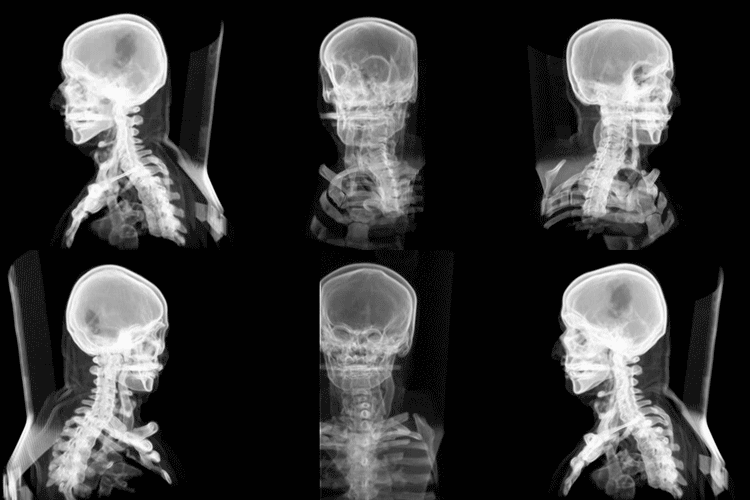
A Computed Tomography (CT) scan of the cervical spine is a highly specialized, non-invasive imaging test that uses advanced X-ray technology to produce detailed, cross-sectional images (slices) of the neck. Specifically, it focuses on the seven cervical vertebrae (C1 through C7), the intervertebral discs, the neural foramina, and the surrounding ligamentous and muscular structures.
Because the cervical spine is the most mobile—and therefore the most vulnerable—segment of the spinal column, high-resolution CT imaging is considered the gold standard for evaluating traumatic bone injuries, acute fractures, and complex structural deformities at the craniovertebral junction (where the skull meets the spine).
Clinical Indications for Neck CT
Neurosurgeons and neurologists frequently order a Cervical Spine CT for the following clinical scenarios:
- Acute Trauma and Whiplash: It is the primary imaging modality used in emergency settings to rule out life-threatening fractures, subluxations, or dislocations (e.g., odontoid fractures of C2, hangman's fractures, or burst fractures) following a car accident or fall.
- Cervical Radiculopathy: When a patient presents with severe neck pain radiating down the arm, accompanied by numbness or weakness in the fingers. CT is excellent for identifying calcified bone spurs (osteophytes) narrowing the neural foramina and pinching the exiting nerve roots.
- Cervical Spinal Stenosis and Myelopathy: To measure the exact sagittal diameter of the spinal canal and evaluate bony encroachment on the spinal cord, which can cause unsteadiness, loss of fine motor skills in the hands, and hyperreflexia.
- Pre-Surgical Navigation: To map the exact trajectory for placing screws during anterior cervical discectomy and fusion (ACDF) or posterior cervical stabilization procedures.
- Contraindications to MRI: A CT scan is the best alternative for visualizing the cervical spine if a patient cannot undergo an MRI due to a pacemaker, severe claustrophobia, or metallic implants.
- Postoperative Assessment: Evaluating hardware placement, fusion success, or complications after cervical spine surgery.
Need Expert Advice on Your Condition?
Get a personalized video breakdown and treatment plan from our senior neurosurgeons using your MRI/CT scans.
👉 Request MRI ReviewThe CT Procedure
A cervical spine CT scan is quick and painless, usually taking less than 10–15 minutes. The patient lies on a motorized table that slides into the CT scanner — a large doughnut-shaped machine. The technologist may ask the patient to hold their breath briefly or remain still. Intravenous contrast is rarely needed for routine cervical spine CT but may be used when evaluating tumors, infection, or vascular issues.
Modern multidetector CT scanners acquire hundreds of thin slices (0.5–1 mm) in seconds, allowing high-quality multiplanar and 3D reconstructions.
Common Findings in the Cervical Spine
A radiologist or neurosurgeon reviewing a cervical CT scan will look for specific pathological markers:
- Osteophyte Formation (Bone Spurs): Advanced cervical osteochondrosis (degenerative disc disease) often results in the body forming extra bone to stabilize a failing joint. If these spurs grow into the spinal canal or foramina, they cause severe nerve compression.
- Ossification of the Posterior Longitudinal Ligament (OPLL): A condition prevalent in the cervical spine where the ligament running down the back of the vertebral bodies turns into bone, compressing the spinal cord. CT is vastly superior to MRI in diagnosing OPLL.
- Facet Joint Arthropathy: Degeneration, sclerosis (hardening), and hypertrophy (enlargement) of the small joints at the back of the neck that allow for head rotation and nodding. This is a primary driver of chronic mechanical neck pain and cervicogenic headaches.
- Atlantoaxial Instability: Abnormal spacing or movement between the C1 (Atlas) and C2 (Axis) vertebrae, which can compress the upper spinal cord or the vertebral arteries, leading to cervico-cranial syndrome or vertigo.
- Fractures and Traumatic Injuries: Including subtle fractures not visible on plain X-rays.
Advantages and Limitations
Advantages:
- Excellent bone detail and 3D reconstructions — superior to X-ray and often preferred over MRI for acute trauma.
- Very fast acquisition — ideal for emergency settings and patients who cannot remain still.
- Widely available and effective for patients with MRI contraindications (pacemakers, implants, claustrophobia).
- Highly accurate for surgical planning and hardware assessment.
Limitations:
- Uses ionizing radiation (though modern dose-reduction techniques significantly lower exposure).
- Less effective than MRI for evaluating soft tissues, spinal cord, or disc herniations without bony involvement.
- May require contrast for certain vascular or infectious conditions.
Patient Preparation and Radiation Safety
Preparation:
- No special preparation is usually required. Patients can eat and drink normally.
- Inform the staff if you are pregnant, have kidney problems, or have a known allergy to contrast.
- Remove jewelry, metal objects, or clothing with metal fasteners from the neck area.
Radiation Safety: The radiation dose for a cervical spine CT is relatively low compared to abdominal or chest CT. Modern scanners use dose optimization protocols. The benefit of accurate diagnosis almost always outweighs the small risk, especially in trauma or when surgery is being considered.
References
- Blackmore CC, Emerson SS, Mann FA, Koepsell TD. Cervical spine imaging in patients with trauma: determination of fracture risk to optimize use. Radiology. 1999;211(3):759-765.
- Daffner RH, Hackney DB. ACR Appropriateness Criteria on suspected spine trauma. J Am Coll Radiol. 2007;4(11):762-775.
- Mizuno J, Nakagawa H, Matsuo N, et al. Delineation of ossification of the posterior longitudinal ligament of the cervical spine using CT and MRI. Spine (Phila Pa 1976). 2001;26(1):84-88.
- Additional sources: American College of Radiology (ACR) Appropriateness Criteria and recent spine imaging guidelines (2023–2026).
See also
- Abdominal CT scan
- Brain and skull base CT scan
- Brain Perfusion CT scan
- Cerebrovascular CT-angiography
- Coronary CT-angiography and computed tomography of the heart
- CT Myelography
- CT study principle
- CT Venography (CTV) of the Brain
- Paranasal sinuses CT scan
- Pelvic CT scan
- Temporal Bone / Internal Auditory Canal CT scan
- Thorax (chest) CT scan
- Vertebral spine CT scan (Overview)
Need Expert Advice on Your Condition?
Get a personalized video breakdown and treatment plan from our senior neurosurgeons using your MRI/CT scans.
👉 Request MRI Review