
Intraoperative Neuromonitoring (IONM)
What is Intraoperative Neuromonitoring (IONM)?
Intraoperative Neuromonitoring (IONM) is an advanced, real-time diagnostic safety protocol used exclusively in the operating room. While the neurosurgeon performs delicate procedures on the spine, brain, or vascular system, a specialized neurophysiologist uses computer technology to continuously monitor the electrical activity of the patient's nervous system.
Because patients are under general anesthesia and cannot report pain or numbness during surgery, IONM acts as an "early warning system." It ensures that critical neural pathways remain intact and fully functional while the surgeon manipulates surrounding tissues, removes tumors, or places spinal hardware.
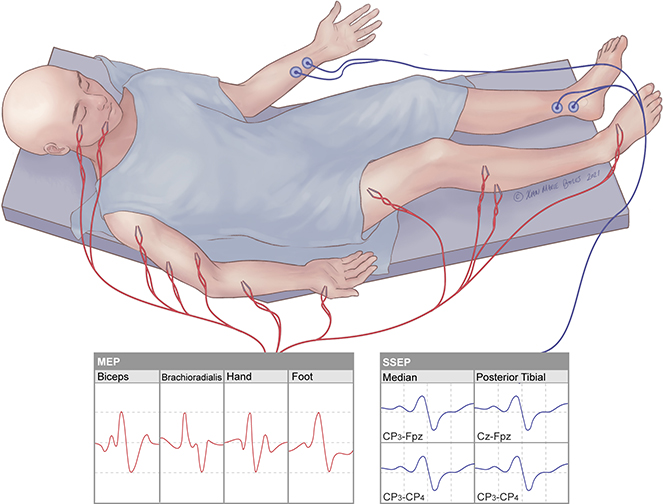
How IONM Protects Patients
During the surgery, small stimulating and recording electrodes are placed on the patient's scalp, limbs, and specific muscle groups. The monitoring team utilizes a combination of advanced functional tests to track different neural pathways simultaneously:
- Somatosensory Evoked Potentials (SSEPs): Stimulates peripheral nerves to ensure sensory signals are successfully traveling up the spinal cord to the brain. This protects the dorsal (back) columns of the spinal cord during scoliosis correction or tumor removal.
- Motor Evoked Potentials (MEPs): Safely stimulates the brain's motor cortex to ensure signals are successfully traveling down the spinal cord to the muscles. This protects the ventral (front) columns of the spinal cord, preventing postoperative paralysis or weakness.
- Electromyography (EMG): Continuously monitors specific muscles for abnormal electrical spikes. If a surgeon's instrument or a spinal screw comes too close to a nerve root, the EMG will instantly alert the team, preventing nerve damage.
- Electroencephalography (EEG): Monitors the brain's overall electrical activity to ensure adequate blood flow (cerebral perfusion) during high-risk cardiovascular or aneurysm surgeries.
If the IONM software detects a drop in signal strength or a delay in transmission, the neurophysiologist immediately alerts the neurosurgeon. The surgeon can then pause, adjust a screw, alter their approach, or relieve tension on a nerve before any permanent neurological damage occurs.
Need Expert Advice on Your Condition?
Get a personalized video breakdown and treatment plan from our senior neurosurgeons using your MRI/CT scans.
👉 Request MRI ReviewSurgical Procedures Utilizing IONM
IONM is considered a critical standard of care in modern, high-risk neurosurgical and orthopedic procedures, including:
- Complex Spine Surgery: Such as spinal fusion, scoliosis correction, and the removal of severe herniated discs or osteophytes in tight spaces.
- Spinal Cord Tumor Resection: Removing tumors (like ependymomas or astrocytomas) from within the delicate tissue of the spinal cord itself.
- Brain Tumor Resection: Utilizing "Brain Mapping" to safely remove tumors located near the eloquent cortex (areas controlling speech, motor function, or vision).
- Cranial Nerve Procedures: Monitoring the facial nerve (Cranial Nerve VII) during the removal of acoustic neuromas or parotid gland tumors to prevent postoperative facial paralysis.
- Vascular Neurosurgery: Monitoring brain perfusion during the clipping of cerebral aneurysms or carotid endarterectomy.
References
- Nuwer MR, Emerson RG, Galloway G, et al. Evidence-based guideline update: intraoperative spinal monitoring with somatosensory and transcranial electrical motor evoked potentials. Neurology. 2012;78(7):585-589.
- Deletis V, Sala F. Intraoperative neurophysiological monitoring of the spinal cord during spinal cord and spine surgery: a review focus on the corticospinal tracts. Clin Neurophysiol. 2008;119(2):248-264.
- Stecker MM. A review of intraoperative monitoring for spinal surgery. Surg Neurol Int. 2012;3(Suppl 3):S174-S187.
See also
- Craniocervical vessels Doppler ultrasonography (UZDG)
- Transcranial Doppler (TCD) ultrasonography
- Electroencephalography (EEG)
- Electromyography (EMG) and Electroneurography (ENG)
- Evoked Potentials (SSEP, MEP, VEP, BAEP)
- Vestibular Testing and Videonystagmography (VNG)
- Intraoperative Neuromonitoring (IONM)
- Lumbar puncture (LP)
Need Expert Advice on Your Condition?
Get a personalized video breakdown and treatment plan from our senior neurosurgeons using your MRI/CT scans.
👉 Request MRI Review