
Vestibular Testing & Videonystagmography (VNG)
What is Videonystagmography (VNG)?
Videonystagmography (VNG) is a series of non-invasive, highly precise tests used to evaluate the health of the inner ear (vestibular system) and the central motor pathways in the brain. It is the modern gold standard for diagnosing the root cause of chronic dizziness, vertigo, and spatial disorientation.
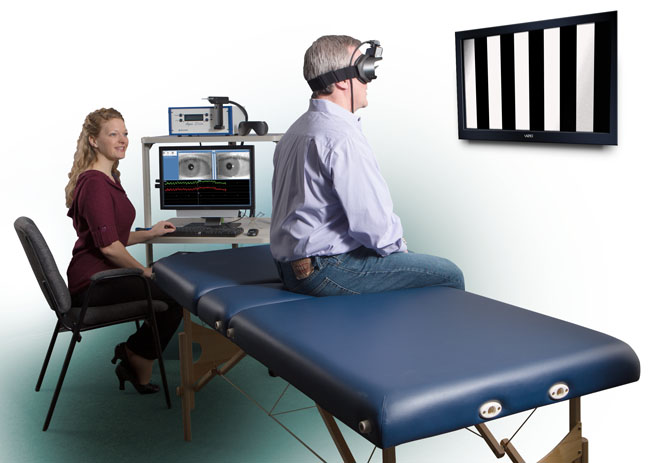
The vestibular system in the inner ear works in constant communication with the eyes to maintain balance. When there is a disruption in this system, the eyes will make involuntary, rapid, and sometimes subtle jumping movements known as nystagmus. VNG uses specialized infrared video goggles to track and record these microscopic eye movements while the patient undergoes various visual, postural, and thermal stimuli.
Clinical Indications for Vestibular Testing
VNG is indispensable for neurologists and neurosurgeons because it definitively separates peripheral (inner ear) dizziness from central (brain/spine) dizziness. It is clinically indicated for:
- Unexplained Dizziness and Vertigo: Determining the origin of chronic unsteadiness or spinning sensations.
- Benign Paroxysmal Positional Vertigo (BPPV): VNG accurately confirms BPPV by mapping eye movements during specific positional changes (like the Dix-Hallpike maneuver).
- Cervicogenic Dizziness: Differentiating true inner-ear vertigo from proprioceptive mismatches caused by neck trauma, such as whiplash injuries or craniocervical syndrome.
- Meniere’s Disease & Vestibular Neuritis: Assessing unilateral or bilateral weakness in the inner ear.
- Central Neurological Disorders: Identifying oculomotor deficits that suggest lesions in the brainstem, cerebellum, or specific cranial nerves.
- Post-Traumatic or Post-Concussion Balance Issues
- Pre- and Post-Surgical Evaluation (e.g., acoustic neuroma, vestibular schwannoma)
Need Expert Advice on Your Condition?
Get a personalized video breakdown and treatment plan from our senior neurosurgeons using your MRI/CT scans.
👉 Request MRI ReviewThe VNG Procedure
The entire VNG test takes approximately 60 to 90 minutes. The patient wears comfortable, dark goggles equipped with infrared cameras that record eye movements even in complete darkness. The evaluation consists of three main phases:
1. Oculomotor Evaluation
The patient follows a moving light target on a screen with their eyes. This tests the central neurological pathways (brainstem and cerebellum) responsible for smooth pursuit, saccades (rapid eye jumps), and gaze stability.
2. Positional and Positioning Testing
The clinician moves the patient's head and body into various positions (e.g., lying flat, turning the head left and right, sitting up quickly). The cameras monitor whether changing the relationship to gravity triggers nystagmus or dizziness. This is the primary method for diagnosing BPPV.
3. Caloric Testing
This is the most definitive test of inner ear function. The clinician gently introduces cool and then warm air (or water) into the ear canal. The temperature change stimulates the endolymph fluid in the semicircular canals, temporarily tricking the ear into thinking the head is turning. This predictably induces nystagmus. By comparing the response of the right ear to the left ear, the doctor can identify unilateral vestibular weakness or paresis.
Interpretation of Results
VNG results are analyzed by comparing eye movement recordings to normative data. Key findings include:
- Peripheral Vestibular Dysfunction: Reduced caloric response on one side, direction-fixed nystagmus, or positional nystagmus that fatigues.
- Central Vestibular Dysfunction: Abnormal oculomotor tests (e.g., impaired smooth pursuit, saccadic dysmetria), direction-changing nystagmus, or persistent non-fatigable positional nystagmus.
- BPPV Patterns: Characteristic torsional-upbeating nystagmus during Dix-Hallpike maneuver.
Results help guide targeted treatment such as canalith repositioning maneuvers, vestibular rehabilitation therapy, or further neurological investigation.
Advantages and Limitations
Advantages:
- Gold standard for differentiating peripheral vs. central causes of vertigo.
- Objective, recorded data (video) that can be reviewed and compared over time.
- Non-invasive and safe — no radiation exposure.
- Highly useful for treatment planning and monitoring recovery.
Limitations:
- Can cause temporary dizziness or nausea during caloric testing.
- Requires patient cooperation (ability to follow instructions and keep eyes open).
- May not detect all vestibular disorders (complementary tests like vHIT, VEMP, or rotary chair testing are sometimes needed).
- Less effective in patients with severe neck mobility issues or certain eye conditions.
Patient Preparation and Aftercare
Preparation:
- Avoid alcohol, sedatives, and certain vestibular suppressant medications (e.g., meclizine, benzodiazepines) for 24–48 hours before the test, if medically safe.
- Do not wear eye makeup.
- Eat a light meal beforehand (to reduce nausea risk).
- Inform the doctor about any neck problems, pacemakers, or perforated eardrums.
Aftercare: Patients may feel dizzy or unsteady for a few hours after caloric testing. It is recommended to have someone accompany them home. Most people can resume normal activities the same day, though some prefer to rest.
References
- Fife TD, Tusa RJ, Furman JM, et al. Assessment: vestibular testing techniques in adults and children: report of the Therapeutics and Technology Assessment Subcommittee of the American Academy of Neurology. Neurology. 2000;55(10):1431-1441.
- McCcaslin DL, Jacobson GP, Bennett ML, et al. Predictive properties of the videonystagmography oculomotor test battery. J Am Acad Audiol. 2009;20(9):571-580.
- Baloh RW, Honrubia V. Clinical Neurophysiology of the Vestibular System. 3rd ed. New York: Oxford University Press; 2001.
- Additional sources: American Academy of Otolaryngology–Head and Neck Surgery (AAO-HNS) guidelines and recent clinical reviews (2023–2026).
See also
- Craniocervical vessels Doppler ultrasonography (UZDG)
- Transcranial Doppler (TCD) ultrasonography
- Electroencephalography (EEG)
- Electromyography (EMG) and Electroneurography (ENG)
- Evoked Potentials (SSEP, MEP, VEP, BAEP)
- Vestibular Testing and Videonystagmography (VNG)
- Intraoperative Neuromonitoring (IONM)
- Lumbar puncture (LP)
Need Expert Advice on Your Condition?
Get a personalized video breakdown and treatment plan from our senior neurosurgeons using your MRI/CT scans.
👉 Request MRI Review