
Arthritis (Joint Inflammation)
- Facts
- What Is
- Types
-
Symptoms and Signs
- What are arthritis symptoms and signs?
- Whom does arthritis affect?
- Rheumatologist
-
Causes
- What causes arthritis?
-
Complications
- What are risk factors for arthritis?
- What are the prognosis (outlook) for arthritis, and what are arthritis complications?
-
Diagnosis
- How do health care professionals diagnose arthritis?
-
Diet
- Is there an arthritis diet?
- Are there foods to avoid when you have arthritis?
-
Treatment
- What are medications and treatment options for arthritis?
-
Prevent
- Is it possible to prevent arthritis?
-
Arthritis Foundation
- What is the Arthritis Foundation?
Arthritis facts
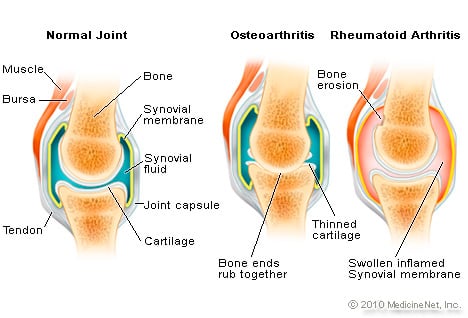
- Arthritis is inflammation of one or more joints.
- Symptoms of arthritis include pain, stiffness, and limited function of joints.
- Arthritis sufferers include men and women, children and adults.
- Osteoarthritis and rheumatoid arthritis are common types of arthritis.
- A rheumatologist is a medical arthritis expert.
- Earlier and accurate diagnosis can help to prevent irreversible damage and disability from joint disease.
What is arthritis?
Arthritis is a joint disorder featuring inflammation. A joint is an area of the body where two different bones meet. A joint functions to move the body parts connected by its bones. Arthritis literally means inflammation of one or more joints.
Arthritis is frequently accompanied by joint pain. Joint pain is referred to as arthralgia. When four or more joints are involved, the arthritis is referred to as polyarthritis. When two or three joints are involved, it is referred to as oligoarthritis. When only a single joint is involved, it is referred to as monoarthritis.
How many types of arthritis exist?
There are many types of arthritis (over 100 identified). The types of arthritis range from those related to wear and tear of cartilage (such as osteoarthritis) to those associated with inflammation resulting from a misdirected immune system (such as rheumatoid arthritis). While osteoarthritis and rheumatoid arthritis are common types of arthritis, there are many other common and uncommon types of arthritis. Other types of inflammatory arthritis include
- psoriatic arthritis,
- ankylosing spondylitis, and
- reactive arthritis.
- Types of infectious arthritis include septic arthritis and Lyme arthritis.
Together, the many types of arthritis make up the most common chronic illness in the United States. Self-limited forms of arthritis can occur in association with virus infections.
What are arthritis symptoms and signs?
Symptoms of arthritis include pain and limited function of joints. Joint inflammation from arthritis is characterized by joint stiffness, swelling, redness, pain, and warmth.
- Stiffness of the joint can lead to poor function.
- Tenderness of the inflamed joint can be present with or without pain.
- When large joints are involved, such as the knee, there can be loss of cartilage with limitation of motion from the joint damage.
- When arthritis affects the small joints in fingers, there can be bone growth and loss of hand grip and grip strength of the hand associated with stiffness.
- Arthritis of weight-bearing joints can lead to difficulty walking from poor joint function and arthritis pain.
Many of the forms of arthritis, because they are rheumatic diseases, can cause symptoms affecting various organs of the body that do not directly involve the joints. Therefore, symptoms in some patients with certain forms of arthritis can also include
- fever,
- gland swelling (swollen lymph nodes),
- weight loss,
- fatigue,
- feeling unwell, and
- even symptoms from abnormalities of organs such as the lungs, heart, or kidneys.
What is a rheumatologist, and what specialties of doctors treat arthritis?
A rheumatologist is a medical doctor who specializes in the nonsurgical treatment of rheumatic illnesses, especially arthritis.
Rheumatologists have special interests in unexplained rash, fever, arthritis, anemia, weakness, weight loss, fatigue, joint or muscle pain, autoimmune disease, and anorexia. They often serve as consultants, acting like medical detectives at the request of other doctors.
Rheumatologists have particular skills in the evaluation of the over 100 forms of arthritis and have special interests in inflammatory arthritis such as
- rheumatoid arthritis,
- seronegative arthritis,
- spondylitis,
- psoriatic arthritis,
- systemic lupus erythematosus,
- antiphospholipid syndrome,
- Still's disease,
- dermatomyositis,
- Sjögren's syndrome,
- vasculitis,
- scleroderma,
- mixed connective tissue disease,
- sarcoidosis,
- Lyme disease,
- osteomyelitis,
- osteoarthritis,
- back pain,
- gout,
- pseudogout,
- relapsing polychondritis,
- Henoch-Schönlein purpura,
Need Expert Advice on Your Condition?
Get a personalized video breakdown and treatment plan from our senior neurosurgeons using your MRI/CT scans.
👉 Request MRI Review