
Abadies Sign
Abadie’s Sign
Abadie’s sign is the absence or diminution of pain sensation when exerting deep pressure on the Achilles tendon by squeezing. This is a frequent finding in the tabes dorsalis variant of neurosyphilis (i.e., with dorsal column disease).
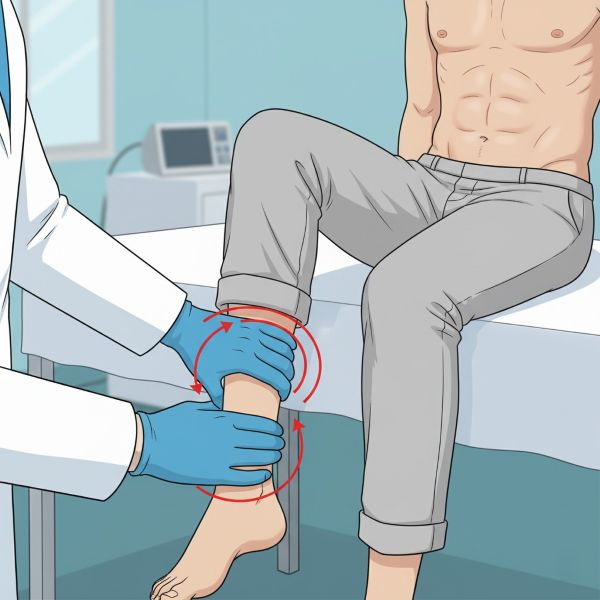
Firm pressure is applied to the Achilles tendon. A positive sign is the absence of a normal pain response.
History and Etymology
The sign is named after Joseph Louis Irénée Jean Abadie (1873–1946), a French ophthalmologist. He first described this clinical finding in patients with tabes dorsalis, noting the characteristic loss of deep pain sensation in the Achilles tendon.
Pathophysiology
The underlying mechanism of Abadie's sign is related to the disruption of sensory nerve pathways. Deep pain and pressure sensations from the Achilles tendon are transmitted to the brain via nerve fibers that travel through the dorsal (posterior) columns of the spinal cord. In conditions like tabes dorsalis, these columns undergo demyelination and degeneration. This damage impairs the transmission of proprioceptive, vibratory, and deep pain signals, resulting in the loss of the expected pain response when the tendon is squeezed.
Clinical Examination Technique
To elicit the sign, a clinician performs the following steps:
- The patient should be in a relaxed position, either seated or lying supine, to ensure the calf muscles are not tense.
- The examiner firmly grasps the Achilles tendon between their thumb and forefinger.
- Gradually increasing pressure is applied to the tendon.
- In a healthy individual, this maneuver causes tenderness or pain. The sign is considered positive if the patient reports little or no pain, indicating insensitivity to deep pressure.
Associated Conditions
While most classically associated with tabes dorsalis, Abadie's sign can also be present in other conditions that affect the dorsal columns or peripheral nerves, including:
- Diabetic neuropathy
- Pernicious anemia (Subacute combined degeneration of the spinal cord)
- Spinal cord injuries or tumors
- Syringomyelia
- Other peripheral neuropathies
Clinical Significance
Historically, Abadie's sign was a valuable clinical tool for diagnosing tabes dorsalis before the advent of modern serological testing for syphilis. Today, its role has shifted. While no longer a primary diagnostic tool, it remains a useful part of a comprehensive neurological examination, especially when a myelopathy or peripheral neuropathy is suspected. Its presence can help localize a lesion to the dorsal columns and prompt further investigation into the underlying cause.
Cross References
References
- Campbell, W. W. (2012). DeJong's The Neurological Examination. Lippincott Williams & Wilkins.
- Kumar, P., & Clark, M. L. (Eds.). (2020). Kumar & Clark's Clinical Medicine. Elsevier.
- Koehler, P. J. (2018). The Abadie sign. In: The neurologist's vade mecum (pp. 1-2).
Need Expert Advice on Your Condition?
Get a personalized video breakdown and treatment plan from our senior neurosurgeons using your MRI/CT scans.
👉 Request MRI Review