
What Heart Rate Is Too High?
What is the heart rate?

Heart rate or pulse rate is the number of times your heart beats in a minute. It is a simple measure to know how much your heart works during rest or activities.
Heart rate is one of the vital signs that are checked regularly whenever you visit your doctor, or when you get admitted to the hospital.
Your heart rate is lower when you are resting and higher when you are doing any kind of activity, or are feeling stressed or anxious.
When you exercise, your heart needs to work harder, which increases your heart rate. As soon as you rest, the heart rate starts decreasing gradually and returns to its normal level, usually within an hour.
How to check your heart rate?

You can check your heart rate by counting your pulse. A pulse can be felt at various sites on the body like over the sides of the neck, the wrist, and the top of the foot. To check your pulse on the wrist with the help of your middle finger and index finger, you need to:
- Keep your middle finger and your index finger over the inner part of the wrist (thumb side) and keep pressing gently until you can feel your pulse. The pulse is felt in your radial artery.
- After you have located your pulse, look at the watch, and start counting the beats for 30 seconds. Doubling this count will give you your heart rate. You can even count the beats for 10 seconds and multiply the number by six to get your heart rate.
If you find the rhythm of your heartbeat slightly irregular, you will have to count the beats completely until 60 seconds. You will have to visit your doctor if you keep getting a fast and irregular heart rate consistently.
What is an average resting heart rate by age?
When you are resting - whether sitting or lying down - you can check your resting heart rate. Provided that you have not smoked, consumed coffee, or exercised vigorously an hour before. Activities such as smoking, having coffee, loud noises, and vigorous physical activity make your heart beat faster for a while, and so you might not get your exact resting heart rate. And hence this may interfere with the correct heart rate.
Average resting heart rate by age chart
| By Age | Average resting heart rate (bpm) |
|---|---|
| Children (ages 6-15 years) | 70-100 beats per minute |
| Adults (age 18 years and older) | 60-100 beats per minute |
What heart rate is too high?
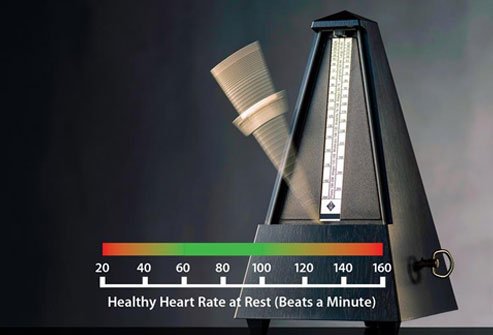
Generally, for adults, a heart rate of more than 100 beats per minute (tachycardia) is considered high.
Your heart rate usually rises when you walk fast, run, or do any strenuous physical activities.
Is a heart rate of 200 bpm bad?
Maximum heart rate and Target Heart Rate
Before doing any vigorous exercise, you should know your maximum heart rate and target heart rate, both of which vary by age.
Going beyond your maximum heart rate is not healthy for you. Your maximum heart rate depends on your age.
- Subtracting your age from the number 220 will give you your maximum heart rate. Suppose your age is 35 years, your maximum heart rate is 185 beats per minute. If your heart rate exceeds 185 beats per minute during exercise, it is dangerous for you. So, 200 beats per minute are bad for you in this case.
- Similarly, if your age is 20 years, your maximum heart rate is 200 beats per minute. So, more than 200 beats per minute heart rate during exercise is dangerous for you.
- If you develop palpitations, an irregular heart rate, shortness of breath, or chest pain, you need to seek medical help right away. This could be a sign of an impending heart attack or other life-threatening heart problems.
- Your target heart rate zone is the range of heart rate that you should aim for if you want to become physically fit. It is calculated as 60 to 80 percent of your maximum heart rate.
- Your target heart rate helps you know if you are exercising at the right intensity.
- It is always better to consult your doctor before starting any vigorous exercise. This is especially important if you have diabetes, heart disease or you are a smoker. Your doctor might advise you to lower your target heart rate by 50 percent or more.
| Age (Years) |
Target Heart Rate (HR) Zone |
Predicted Maximum Heart Rate |
| 20 | 120-170 | 200 |
| 25 | 117-166 | 195 |
| 30 | 114-162 | 190 |
| 35 | 111-157 | 185 |
| 40 | 108-153 | 180 |
| 45 | 105-149 | 175 |
| 50 | 102-145 | 170 |
| 55 | 99-140 | 165 |
| 60 | 96-136 | 160 |
| 65 | 93-132 | 155 |
| 70 | 90-128 | 150 |
If you exercise regularly, or if you are an athlete, you may have a lower heart rate. Research says that a low resting heart rate is healthy for your heart.
Your aim should be to keep doing moderate-to-vigorous exercises regularly. This will help you lower your resting heart rate in the long run.
How to achieve a healthier lower heart rate

A heart rate lower than 80 beats per minute is associated with a lowered risk of dying from a heart attack according to the American Heart Association.
Staying physically active by doing moderate to vigorous exercise regularly is one of the best ways to achieve a lower heart rate that leads to a healthy and long life.
Changes in your lifestyle that may lower your heart rate include:
Need Expert Advice on Your Condition?
Get a personalized video breakdown and treatment plan from our senior neurosurgeons using your MRI/CT scans.
👉 Request MRI Review