
Annular Scotoma
Definition and Clinical Features
An annular scotoma, also known as a ring scotoma, is a circular area of depressed or absent vision that forms a continuous ring around the central point of fixation. In this specific pattern of visual field loss, the very center of vision is typically spared, as is the extreme peripheral vision, at least in the early to middle stages of the causative disease.
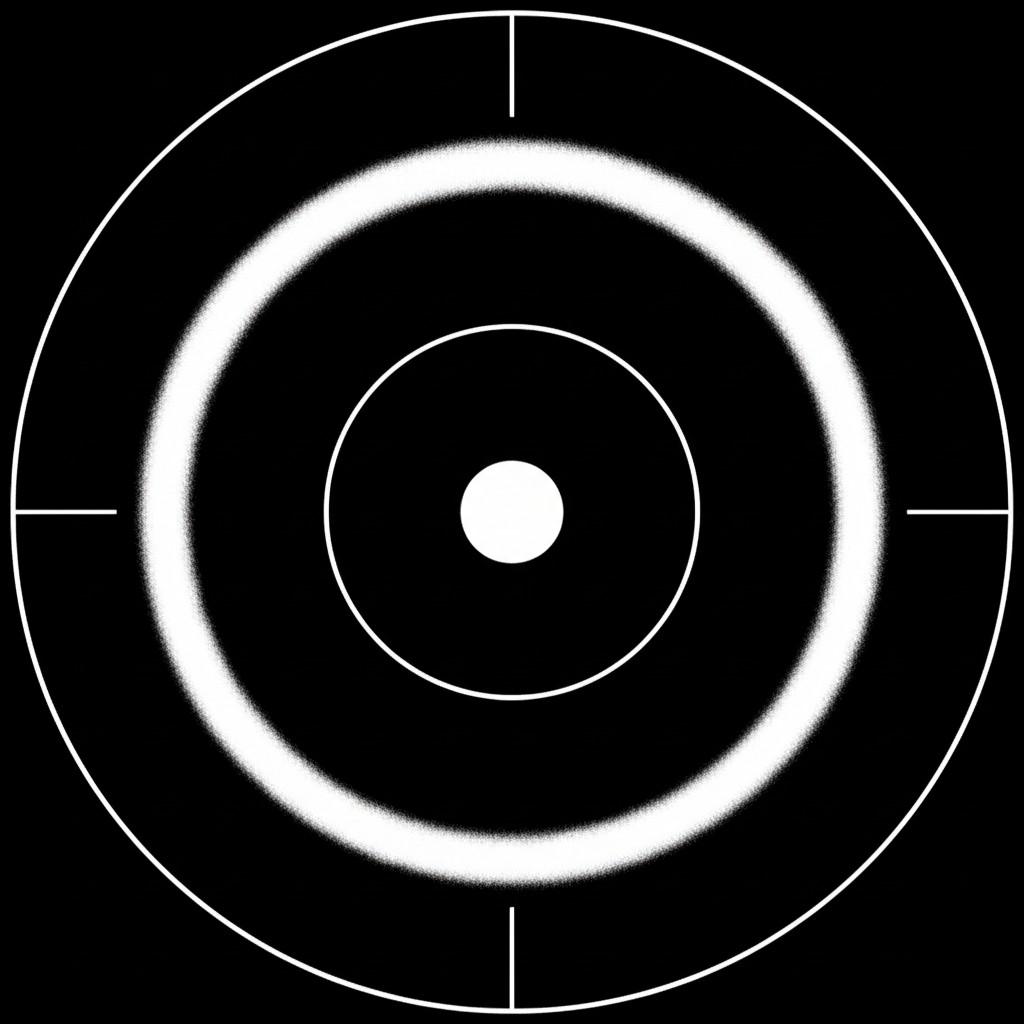
A visual field map demonstrating an annular (ring) scotoma, characterized by a circular band of visual loss that spares the central macula.
Pathophysiology
The development of an annular scotoma generally points to pathology affecting the mid-peripheral retina. The rod photoreceptors, which are primarily responsible for peripheral and night vision, are most densely concentrated in this mid-peripheral zone. Therefore, degenerative conditions that preferentially target the rods or the pigment epithelium in this region will manifest clinically as a ring-shaped visual defect.
Clinical Examination Technique
An annular scotoma is mapped and quantified using formal visual field testing (perimetry). Automated static perimetry (e.g., Humphrey Visual Field Analyzer) or manual kinetic perimetry (e.g., Goldmann perimetry) can accurately outline the inner and outer margins of the ring defect. Patients themselves may not initially notice the scotoma because their central visual acuity remains sharp, but they may complain of navigating difficulties, frequent tripping, or poor night vision (nyctalopia).
Associated Conditions
An annular or ring scotoma strongly suggests retinal disease. It is a hallmark sign in several neuro-ophthalmologic and retinal conditions, including:
- Retinitis Pigmentosa: A hereditary retinal dystrophy where rod photoreceptors degenerate early on, leading to night blindness and a progressive ring scotoma that eventually constricts into "tunnel vision."
- Cancer-Associated Retinopathy (CAR): A paraneoplastic retinal degeneration where autoantibodies (such as anti-recoverin) attack the photoreceptors, leading to rapid, bilateral visual loss and ring scotomas.
- Glaucoma: In advanced stages, superior and inferior arcuate (Bjerrum) scotomas may join together to form a complete ring around the central fixation point.
- Toxic Retinopathies: Certain medications, such as chloroquine or hydroxychloroquine, can cause a "bull's-eye" maculopathy that may present similarly to a small paracentral ring scotoma.
References
Walsh FB, Hoyt WF. Clinical Neuro-Ophthalmology (6th edition). Lippincott Williams & Wilkins, 2005
Biousse V, Newman NJ. Neuro-Ophthalmology Illustrated (2nd edition). Thieme, 2012
Cross References
Retinopathy; Scotoma; Visual field defects
Need Expert Advice on Your Condition?
Get a personalized video breakdown and treatment plan from our senior neurosurgeons using your MRI/CT scans.
👉 Request MRI Review